
From Subgrade to Superstructure: How Construction Materials Testing and Inspection Works
Every construction project starts in the ground and ends in the sky. Between those two points, there are dozens of inspection and testing milestones that determine whether a structure is safe, compliant, and built to last. Miss one, and you're looking at rework, failed inspections, or worse.
Construction materials testing and inspection isn't a single event. It's a continuous process that runs parallel to construction itself, from the first soil compaction test on a raw site to the final fireproofing inspection before a building opens its doors. For CMT firms managing multiple projects and crews, keeping that process organized and documented is one of the most demanding operational challenges in the industry.
Here's a look at what that process actually involves, why tracking it matters at every stage, and how modern software keeps everything connected.
What is Construction Materials Testing and Inspection?
CMT refers to the systematic process of evaluating construction materials and workmanship to verify that they meet project specifications, applicable standards, and building code requirements. It encompasses both laboratory testing of materials like concrete, soil, and asphalt, and field inspections conducted during active construction.
According to the American Society for Testing and Materials (ASTM) , standardized testing procedures exist for virtually every material used in construction, from the compressive strength of concrete cylinders to the density of compacted subgrade soils. These standards are the backbone of CMT work, and ensuring your team documents compliance with them at every phase is what accreditation reviewers, clients, and building officials expect to see.
The Inspection Lifecycle: Phase by Phase
Phase 1: Earthwork & Subgrade
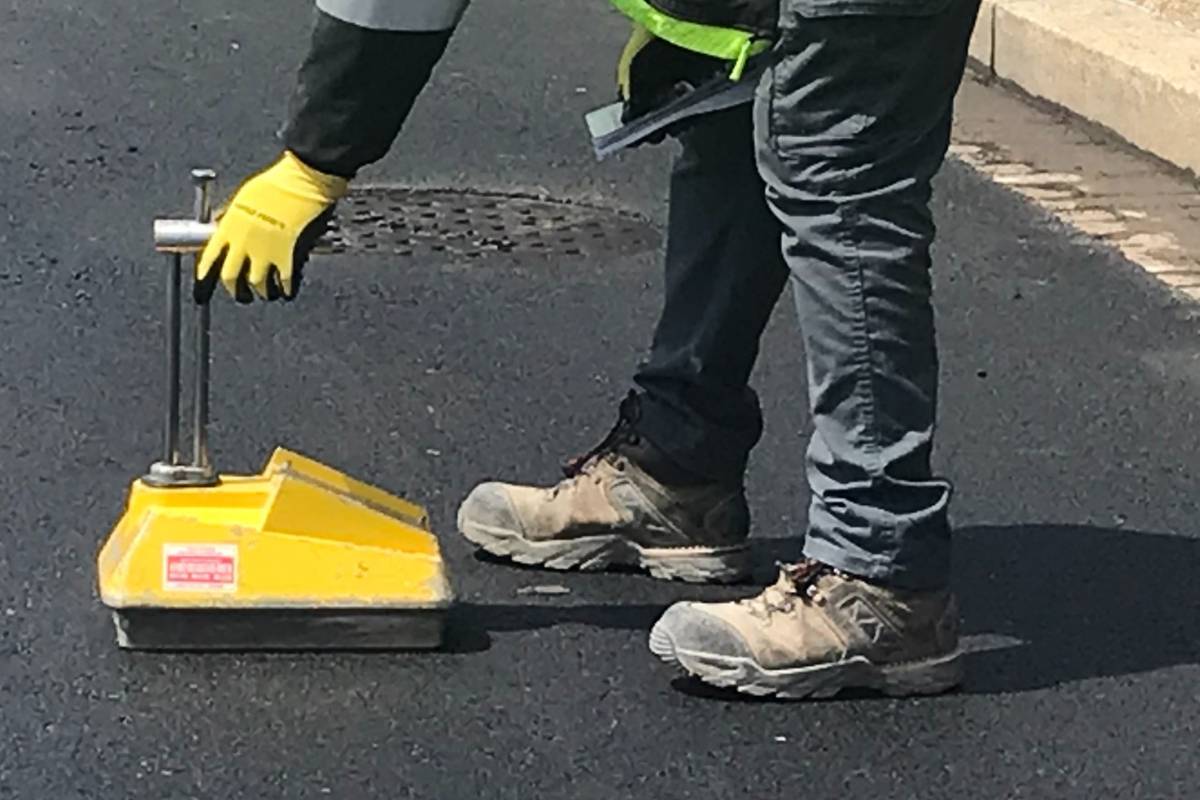
Everything starts at the ground level. Before a single footing is poured, CMT technicians are on site performing soil compaction testing to verify that the subgrade can support the loads the structure will impose on it. This typically involves nuclear density gauge testing per ASTM D6938, proctor testing per ASTM D698 or D1557 to establish maximum dry density and optimum moisture content, and documentation of test locations tied to GPS coordinates or site drawings.
Earthwork is often the most logistically complex phase of CMT work. Tests happen across large areas, multiple lifts of compacted fill need to be verified before the next lift begins, and results need to get back to the lab and the project manager quickly enough to keep construction moving. A delay in test results at this stage can hold up an entire project.
The U.S. Army Corps of Engineers notes that subgrade soil testing is among the most critical quality control activities on any civil construction project, as failures at this stage are among the most costly to remediate once construction is underway.
Phase 2: Foundations & Concrete
Once the subgrade is verified, concrete work begins. Foundation pours, footings, grade beams, and slabs all require testing at the time of placement. CMT technicians collect fresh concrete samples and perform slump tests (ASTM C143), air content tests (ASTM C231), and temperature checks (ASTM C1064). Compression test cylinders are cast on site and transported to the lab for break testing at intervals of 7, 14, and 28 days.
Tracking this phase requires careful chain of custody documentation. Each cylinder needs to be tied back to the pour it came from, the truck it arrived on, the time it was cast, and the technician who cast it. Lose that chain, and the test results become meaningless to the structural engineer reviewing them.
Phase 3: Structural Steel
For projects with structural steel frames, a new set of inspection requirements kicks in. Special inspectors certified by the International Code Council (ICC) are required by the International Building Code (IBC) Chapter 17 to verify bolted connections, welding quality, and the steel's mill certifications before elements are concealed by other construction. For projects involving on-site welding, Certified Welding Inspectors (CWI) credentialed through the American Welding Society (AWS) are also required to verify welds for safety and code compliance.
Unlike concrete, which gains strength gradually, structural steel connections are loaded almost immediately after installation. That makes pre-concealment inspection timing critical. Missed inspections at this phase can't be corrected after the fact without significant cost and delay.
Phase 4: Masonry & Specialty Systems
Masonry construction brings its own testing requirements, including grout sampling, prism testing, and verification of mortar mix designs. Specialty systems such as fireproofing, post-installed anchors, and high-strength bolting also require documented inspection by qualified personnel.
Fireproofing inspection, for example, involves verifying the thickness and adhesion of spray-applied fire-resistant materials per ASTM E605 . These inspections are easy to overlook in the busy mid-construction phase, but they're consistently flagged by building officials when documentation is missing at project closeout.
Phase 5: Final Inspections & Closeout
As a project approaches completion, the inspection documentation accumulated over the entire project lifecycle becomes a deliverable in its own right. The IBC requires a final report confirming that all items in the Statement of Special Inspections have been addressed and that no unresolved nonconformances remain. Pulling that documentation together from paper files, email threads, and shared drives at the end of a long project is one of the most common pain points CMT firms report.
Why Tracking Matters at Every Stage
The challenge of construction materials testing and inspection isn't just doing the work. It's creating a documented, auditable record that proves the work was done correctly, by qualified personnel, using calibrated equipment, in accordance with applicable standards.
That record serves multiple purposes. It protects the project owner from liability. It gives the structural engineer of record confidence in the work. It satisfies the building official. And for accredited CMT labs, it's the evidence base that AASHTO, CCRL, and other accreditation bodies review to determine whether your quality management system is functioning the way it should.
When documentation is fragmented across paper forms, spreadsheets, and email attachments, critical items fall through the cracks. Equipment calibrations expire unnoticed. Technician certifications lapse before anyone realizes it. Test results get separated from the samples they came from. Any one of these gaps can create problems during an accreditation review or a project dispute.
How Omnant Keeps the Full Lifecycle Connected
Omnant's construction materials testing software is built to support the full inspection and testing lifecycle, from first dispatch to final report delivery. Here's how it addresses the specific challenges of each phase.
- Field inspections. Technicians complete inspection reports on their mobile devices at the job site, with data flowing directly into the system rather than being retyped later in the office. GPS coordinates, site photos, and test results are captured at the point of work. Learn more about Omnant's field inspection tools .
- Lab testing and reporting. Concrete cylinder breaks, soil analysis, and asphalt testing are tracked through a centralized lab hub. Sample intake, test scheduling, and report generation are integrated into a single workflow, eliminating the manual handoffs that create errors and delays. Every specimen is tracked from the moment it's cast in the field to the moment it's broken in the lab, with a complete digital chain of custody that satisfies both client requirements and accreditation standards. See how Omnant supports lab testing and reporting .
- Equipment calibration tracking. Omnant tracks calibration schedules and expiration dates for all your testing equipment, with automated notifications so nothing expires between inspections. Find out how equipment tracking works.
- Certification management. Technician certifications, including ACI, NICET, and ICC credentials, are stored in the platform with expiration tracking and alerts. Dispatchers can verify that the right certified tech is assigned to each job before the schedule is posted. Learn about certification tracking .
- Scheduling and dispatch. From earthwork through closeout, Omnant's scheduling system coordinates technician assignments, equipment availability, and client-facing inspection requests in one place. Explore the scheduling system.
- Document control. SOPs, mix designs, site drawings, and project-specific forms are stored and version-controlled in the platform, so your team is always working from the most current documentation. See how document control works.
- Quality system. Nonconformances, corrective action reports, and AASHTO R18 compliance documentation are tracked within Omnant's quality management system, so you're audit-ready throughout the project, not just scrambling before a review. Learn about Omnant's quality system.
The Cost of Disconnected Documentation
If your team is managing CMT work across multiple projects with paper forms, shared drives, and spreadsheets, you already know the pressure points. The end-of-season report scramble. The last-minute search for a cylinder break result from six months ago. The accreditation reviewer asking for documentation that should be easy to find.
According to research from McKinsey & Company , construction productivity has remained relatively flat for decades compared to other industries, with administrative inefficiencies and fragmented data management identified as significant contributing factors. For CMT firms, that inefficiency shows up most clearly in the time spent chasing documentation rather than doing the technical work clients are paying for.
A unified platform that tracks every inspection from subgrade to superstructure doesn't just save time. It creates the kind of transparent, organized record that builds trust with clients, satisfies accreditors, and protects your firm when questions arise about the quality of work performed.
From First Test to Final Report
Managing construction materials testing and inspection across multiple projects is demanding enough without chasing down missing documentation, tracking expired calibrations, or scrambling before an accreditation review. Omnant brings every phase of the process into one connected platform, from the first soil compaction test on a raw site to the final report that closes out the job.
Whether you're running a single crew or coordinating work across multiple locations, you get the visibility, documentation, and compliance tools to operate with confidence at every stage. Schedule a demo to see how it works for a firm like yours.
Share this Post:
Related Blog Post


Start streamlining your inspection and CMT testing processes with Omnant's integrated solution. Contact us today to learn how our software can support your goals for operational excellence.